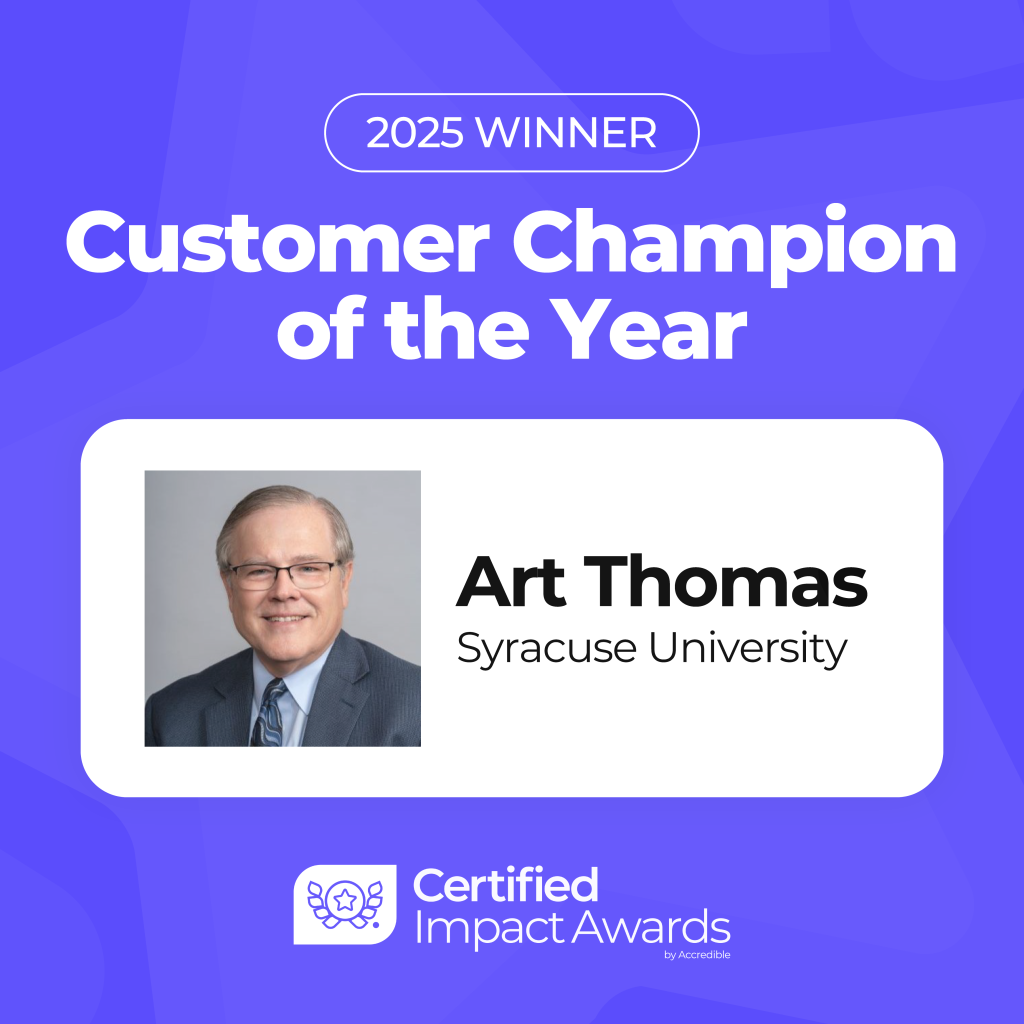
Arthur Thomas, Executive Director of Microcredentials has been named a winner in the Certified Impact Awards 2025, presented by Accredible, the world’s leading digital badging platform. Thomas received top honors in the Customer Champion of the Year category, which recognizes an individual who has gone above and beyond to champion Accredible through public advocacy, peer support, platform feedback, and community participation.
The Certified Impact Awards 2025 celebrate credentialing programs, teams, and leaders shaping the future of learning and work. Winners were selected from more than 175 nominations across ten categories through a rigorous evaluation of clarity, relevance, and demonstrated impact — spanning operational transformation, credentialing innovation, learner outcomes, and workforce results.
“Through the continued growth and impact of our programs, the College of Professional Studies has strengthened its ability to support the evolving needs of Syracuse University’s academic and administrative units,” said Arthur Thomas. “Our partnership with Accredible has been instrumental in this progress, enabling us to deliver innovative credentialing solutions that enhance engagement, expand professional development opportunities, and promote career success across our diverse participant communities.”
By working in true collaboration with Accredible, the College of Professional Studies has not only advanced their own initiatives but has also contributed to shaping the current and future direction of digital credentialing on an international scale.
“The Certified Impact Awards shine a spotlight on the teams who are building meaningful, learner-first credentialing programs and proving what digital recognition can achieve,” said Dan Theckston, Chief Customer Officer at Accredible. “This year’s winners aren’t just issuing credentials. They’re using them to drive mobility, spark innovation, and create real-world value for learners and industries alike.” To explore all Certified Impact Awards 2025 winners and learn more, visit here.
About The College of Professional Studies
Syracuse University College of Professional Studies innovates future-ready programs in flexible formats, so learners and leaders can advance their education and careers beyond what they imagined possible. From bachelor’s and master’s degrees to executive education, certificates and more, our credit and noncredit programs empower students to pursue their passions and purpose on their terms and timeline.
About Accredible
Accredible is the world’s leading digital credential platform, enabling education and training leaders to increase learner engagement and drive program growth. Over 2,300 organizations, including Google, IAPP, McGraw Hill, Rutgers, Skillsoft, and the University of Cambridge, rely on Accredible to manage and measure everything from issuing digital certificates and badges to visualizing learning pathways to spotlighting certified learners. Founded in 2013, Accredible has helped issue and verify over 170 million career-advancing credentials. To learn more, visit accredible.com.
The cannabis industry is booming—and employers are looking for skilled professionals with formal training. That’s why the College of Professional Studies has partnered with Green Flower, the leader in cannabis education, to launch a new suite of Cannabis Career Certificate programs.
Why Choose Cannabis Career Certificates?
These online programs are built for real-world success:
Expert-Led Learning: 50+ cannabis industry leaders and subject matter experts.
Updated Curriculum: Aligned with current regulations and employer needs.
Affordable Pricing: Accessible programs starting at $850.
Career Support: Access to Green Flower’s Cannabis Career Resource Center for resume help, interview prep, and employer connections.
Six Career-Focused Cannabis Certificates
Each program is designed to match the most in-demand roles in the cannabis industry:
Cannabis Associate Certificate (8 weeks, $850) Gain foundational knowledge in cannabis policy, plant science, and compliance—perfect for entry-level roles.
Cannabis Cultivation Specialist (16 weeks, $2,200) Learn best practices for growing cannabis in indoor, outdoor, and greenhouse environments.
Cannabis Product Development Specialist (16 weeks, $2,200) Master the process of creating cannabis products, from extraction to edibles, beverages, and topicals.
Cannabis Retail & Sales Specialist (16 weeks, $2,200) Build skills for dispensary operations and brand sales success.
Cannabis Compliance Specialist (16 weeks, $2,200) Understand regulations and compliance for cultivation, retail, and manufacturing.
Medical Cannabis Specialist (16 weeks, $2,200) Prepare for patient-focused roles with training in safe and effective cannabis use.
Career Support That Goes Beyond Education
Every student receives access to:
Continuing Education Hub: Resume and interview resources, leadership development, and entrepreneurship tips.
Employer Access: Direct links to vetted cannabis companies hiring now.
Exclusive LinkedIn Community: Network with peers and industry professionals.
Microcredentials at Syracuse University
Cannabis Career Certificates are part of the Syracuse University College of Professional Studies commitment to flexible, workforce-aligned microcredentials. Like our other microcredential programs, they provide industry-recognized certifications that help professionals gain targeted skills without committing to a full degree—perfect for career changers or those looking to upskill quickly.
Syracuse University and Tompkins Cortland Community College (TC3) and have announced a new transfer agreement that provides TC3 graduates a direct transfer pathway into online bachelor’s degree programs in the College of Professional Studies at Syracuse University. The agreement, which was formally signed into effect by TC3 President Amy Kremenek and College of Professional Studies Dean Michael Frasciello, offers TC3 graduates discounted tuition rate for these undergraduate online degree programs.
For three consecutive years, the College of Professional Studies is leading Syracuse University’s support for veterans and military-connected students.
As of fall 2025, 19% of all currently serving military students attending Syracuse University are enrolled in College of Professional Studies degree programs. Currently serving military students are service members on active duty, National Guard or reserve status. This leadership is driven by the College of Professional Studies’ innovative and progressive work to standardize the University’s Military Credit Evaluation, which evaluates military technical training and professional military education for academic credit.
“Bachelor of Professional Studies degrees are designed specifically for individuals like currently serving members of the armed forces juggling service obligations and life responsibilities with their educational goals,” says Michael Frasciello, Dean of the College of Professional Studies. “We offer an accessible combination of flexibility, applied and focused career preparation, progressive credit transfer [up to 90 credits], and recognition of military experience and training.”
Currently serving military students admitted to the College of Professional Studies’ BPS programs are being recommended and awarded an average of 30 equivalency credits for their military technical training and professional military education.
Diverse Support for Military-Connected Students:
The College of Professional Studies supports 33% of all military-connected students at Syracuse University, including active duty, veterans, and military dependents.
Under our nationally recognized Military Advising Model, the College of Professional Studies has achieved skyrocketing persistence and graduation rates.
Persistence Rate
College of Professional Studies: 93%
National Average: 45%
Graduation Rate
College of Professional Studies: 70%
National Average: 20%
“Our ability to successfully support one-third of the University’s military-connected students is only possible because of our advisors who are specifically trained to understand the unique challenges military-connected students face,” says Liz Green, executive director of the student experience for Online Student Success. “This success starts with a recognition that military-connected students are non-traditional, adult learners with distinct needs.”
The College provides holistic support that proactively addresses academic, administrative, and military service-related challenges, such as deployment interruptions, VA benefits navigation, credit transfer from military training, and work-life-study balance, in an integrated way.
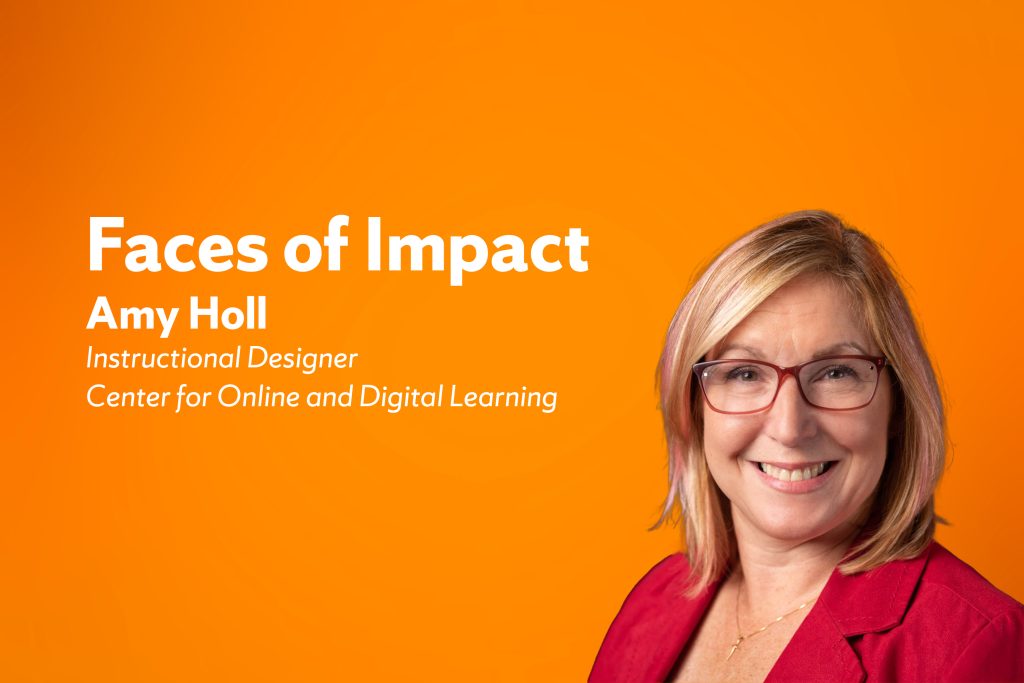
With a deep commitment to inclusive, student-centered learning, Holl plays a pivotal role in shaping engaging and accessible online courses that meet the needs of a diverse, global student body. Her work exemplifies the College of Professional Studies’ mission to provide flexible, high-quality education that meets students where they are and helps them thrive.
What is your current role and what does it involve?
I am an instructional designer. I work with faculty (SME – Subject Matter Experts) and a team of colleagues to design and develop courses for online delivery across academic programs at Syracuse University.
In one sentence, how would you describe your department’s mission?
Our mission is to develop student-centered, engaging, rigorous, and inclusive learning opportunities for a diverse and global community of learners.
Why is instructional design an important part of the course development process?
Instructional design organizes course content and brings the course to life for the students.
Instructional designers use frameworks and ideas from learning theories like constructivism, andragogy, and experiential learning to design activities that help students connect concepts, ask questions, and build knowledge in ways that stay with them. When a course is thoughtfully designed, it’s easier for students to stay engaged, know what’s expected, and feel like the learning really matters.
Instructional design plays a vital role in creating meaningful learning environments that support how students learn most effectively.
In what ways does your team go above and beyond to serve online students?
Intentional, inclusive, and supportive course design is how our team goes above and beyond for online students. Students benefit from clear expectations, easy navigation, and engaging content that keeps them connected to their learning.
Every course is built with care, drawing on the deep expertise and creativity of our team to deliver high-quality learning opportunities with multimedia that supports student success. By focusing on best practices and listening and adapting, we make sure each student feels valued and equipped to succeed. We also prioritize authentic and inclusive pedagogy by designing for diverse learning preferences and encouraging adaptive strategies that help students meet complex learning goals.
How do you collaborate with faculty or subject matter experts during the instructional design process?
Planning Together: We meet with faculty throughout the process to talk through course goals, delivery format, timelines, aligning learning objectives with activities and student needs. This helps faculty think through how their content can be structured to support different learning preferences and students from varied backgrounds.
Rethinking Assignments: In collaboration with faculty, we redesign assignments to be more inclusive and flexible, allowing students to create materials that are relevant to their professional goals. We design course content that is relevant, engaging, and structured to support online and non-traditional learners in accessing and understanding material with ease. Our approach emphasizes authentic learning and supports the development of adaptive strategies that help students navigate complex tasks, build confidence, and apply their knowledge in real-world contexts.
Targeting Student Needs: We work closely with faculty to identify assignments and activities that meet the objectives for the course and also the needs of diverse online learners, including adult students, working professionals, caregivers, military-affiliated learners, and others balancing education with competing responsibilities. Our team offers flexible alternatives to traditional assessments and delivery formats that still meet learning outcomes while providing more choice and accessibility. For example, instead of a timed exam, we might suggest students create a podcast, video, or infographic that demonstrates their mastery of course content in a way that aligns with their professional goals and lived experiences.
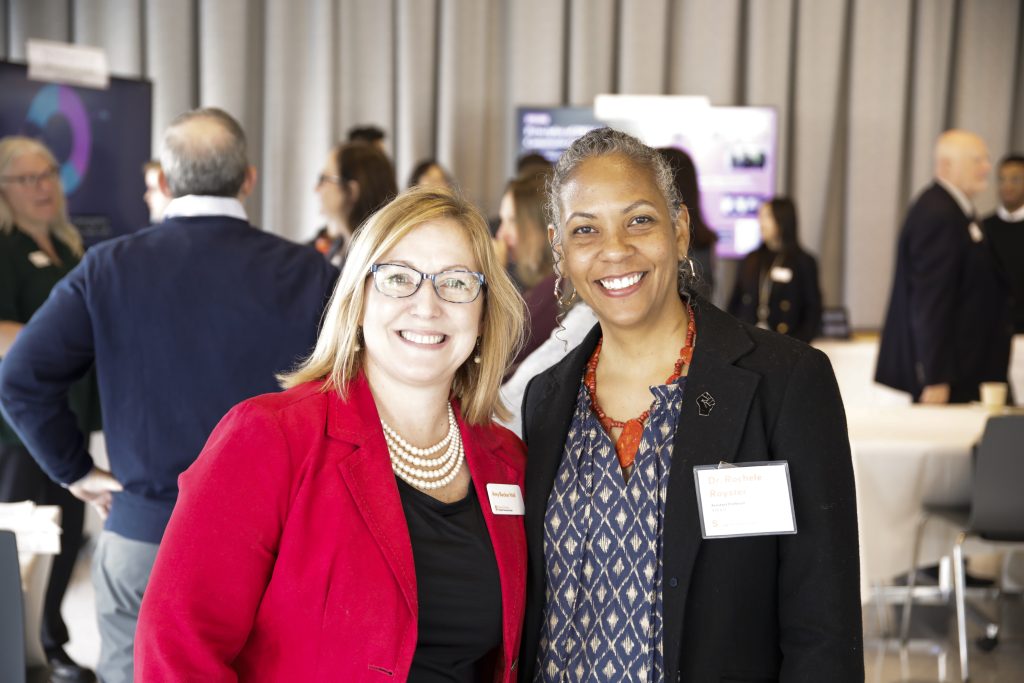
Left to right: Amy Holl and Rochele Royster at the Center for Online and Digital Learning Spotlight 2025.
How do you approach designing online courses to ensure they’re accessible to all learners?
When designing online courses, I prioritize inclusive pedagogy to ensure all learners feel welcomed and supported. This approach is grounded in key principles such as equity, accessibility, representation, flexibility, and empowerment, which guide every aspect of course development, from content creation to interaction and assessment design.
In our courses we ensure we use alt text for images, captioning and transcripts for media, clear and consistent navigation, high-contrast colors and readable fonts, keyboard-accessible interactions, chunked content with clear headings, flexible assignment formats, and accessible documents that work seamlessly with assistive technologies. Using inclusive pedagogy, we actively seek to create learning environments where all students feel valued, respected, and supported, regardless of their backgrounds, identities, or abilities.
As I work on courses, I want the materials to be thoughtful, artful, and impactful. Additionally, I want students to see themselves reflected in the content and feel that their personal perspectives and contributions are acknowledged and valued.
What makes the College of Professional Studies stand out as a leading environment for teaching and learning?
We have the finest committed, caring and passionate team members that are student-centered. The College of Professional Studies stands out as a leading environment for teaching and learning because of its strong commitment to access, inclusion, and innovation.
Under the leadership of Dean Michael Frasciello, the College empowers diverse learners, including part-time and nontraditional students, through flexible, future-focused programs that combine academic excellence with real-world relevance. The College’s student-centered approach includes personalized support, interdisciplinary degrees, and high-quality online and on-campus options designed to meet learners where they are and help them succeed on their own terms.
My Personal Commitment: As a first-generation college graduate and passionate instructional designer, I am deeply committed to creating inclusive, student-centered online learning environments that support the educational needs and aspirations of diverse learners. I look forward to continuing this work in ways that have a meaningful impact on our students.